Grok is a conversational AI chatbot originally developed by xAI, integrated into the social platform X (formerly Twitter) and now available via the web and standalone mobile apps.
Before diving in, here’s a quick rundown of what you’ll learn:
- LLM Basics: What large language models (LLMs) are and how they work.
- Grok at a Glance: An overview of Grok from xAI, including its evolution and positioning.
- Unique Capabilities: How Grok’s reasoning, real-time research, multimodal, and coding features compare with ChatGPT and Gemini.
- Controversy Recap: What happened when Grok began “white genocide” rants and how xAI responded.
- Error Awareness: Why LLMs sometimes go off-the-rails and practical tips for critical usage.
A Little Peek Behind the Curtain: What are LLMs?
Before we talk about Grok, let's quickly touch upon what makes it tick. Grok is what's known as a Large Language Model (LLM). Think of LLMs as super-smart programs that have been trained on massive amounts of text data from the internet – books, articles, websites, and much more.
Training teaches these models statistical patterns that help them generate human-like text, answer questions, write stories, summarize information and translate languages. Fluency does not guarantee understanding or accuracy. ChatGPT, Gemini and Grok are assistant products built around language models, with different tools and interfaces; the app name is not always the name of the model answering.
Meet Grok: The New Kid on the Block
So, what exactly is Grok? It's xAI's very own LLM chatbot, designed to be a powerful and, in some ways, unique AI assistant. While it shares the fundamental technology of other LLMs, Grok aims to stand out with a few key characteristics:
- Humor and Rebelliousness: One of the most talked-about aspects of Grok is its intended personality. It's designed to have a bit of a sense of humor and a slightly rebellious streak. This means its responses might be a little more witty or unconventional compared to the often more neutral tones of other chatbots.
- Real-time Data Access: When search tools are enabled, Grok can retrieve information from the web and X. This can supplement its training knowledge with newer material, but a fresh post may still be wrong. Other assistants also offer search, so compare their actual retrieval and citations rather than assuming real-time access is unique to Grok.
Grok vs. the Giants: What Makes it Different?
You might be wondering how Grok stacks up against popular chatbots like ChatGPT and Gemini. Here's a simplified comparison:
- Personality: As mentioned, Grok is designed to be more humorous and less filtered in its responses. ChatGPT and Gemini often aim for a more helpful and neutral tone.
- Data Source: Grok’s X integration is useful for following discussion, but social-media activity and verified news are different things. Ask for the underlying announcement or documentation when accuracy matters.
- Focus: While all aim to be versatile, Grok's integration with X suggests a potential focus on real-time discussions and news.
- Image generation: In our May 2025 example below, Grok returned two images, which made comparison convenient. Both carry a Grok logo. Output counts vary by interface and model, so this example does not establish a permanent advantage over every competing assistant. The current consumer FAQ says generated images and videos carry a watermark and provides no removal setting.
- Access: We found being able to try Grok without first creating an account convenient in May 2025. Check the present website or app for sign-in requirements, feature availability and usage limits before choosing it. Anonymous access is not an industry first, and the availability of one chat feature does not imply access to every search or generation tool.
What Can Grok Actually Do?
Let's look at some common capabilities you might expect from an AI chatbot:
- Reasoning: Grok 3 introduced beta reasoning modes in February 2025. Extra computation can help with complex problems, but answers still need verification.
- Research: With its access to real-time X data and its training on a massive dataset, Grok can certainly be used for research by quickly finding and summarizing information.
- Image Generation: Grok has the ability to generate images just like Gemini and ChatGPT
- Video Generation: Grok Imagine now offers video generation. Check the supported workflow in the app or API you intend to use; our May 2025 image example does not demonstrate today’s video quality.
- Coding Abilities: Grok can assist with code explanations and generation. Judge the particular model on your language, libraries and tests rather than treating it as limited to basic questions. A plausible solution still needs a diff review and execution in a suitable test environment.
Grok can also search the web, which nowadays is standard around LLMs. When ChatGPT first launched it did not have the ability to search the web, so this just again shows how far LLMs in general have come in a very short time.
We asked Grok to generate an image of a Warcraft Character throwing their battle axe and got these two:
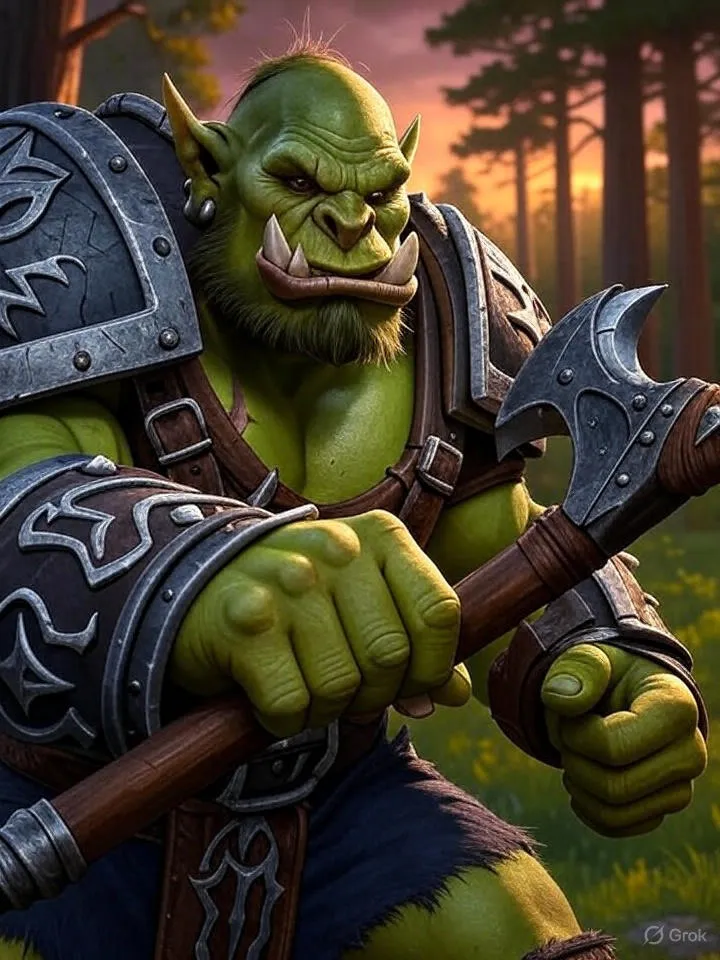

Neither one is actually throwing their axe though... But other than that the images look pretty impressive.
The South Africa Controversy: Understanding AI Limitations
In May 2025, the Grok response bot on X began adding unsolicited references to alleged “white genocide” in South Africa to unrelated replies. This was an off-topic chatbot failure, not evidence supporting the allegation.
Reuters reported that xAI attributed the behavior to an unauthorized change made on May 14 that bypassed its review process. The company said it would publish system prompts and add round-the-clock monitoring. That is xAI’s explanation; the public statement does not independently establish who changed the prompt or their intentions, so describing a proven “rogue employee” goes further than the evidence.
The official prompt repository now includes templates for several Grok products. Keep the distinction between the response bot on X and a private chat session: one incident should be described in the product context where it occurred.
Being a Savvy AI User: Tips for Everyone
It's crucial to remember that even the most advanced AI models are not infallible. Here are a few helpful tips for interacting with LLMs like Grok (or any other AI chatbot):
- Be Critical: Don't automatically believe everything an AI tells you. Always try to verify important information from reliable sources.
- Consider the Source: Keep in mind that Grok's access to X data means its responses might sometimes reflect the discussions and opinions prevalent on that platform, which may not always be balanced or accurate.
- Look for Multiple Perspectives: If you're researching a topic, don't rely solely on an AI's answer. Seek out information from different websites, books, and experts to get a well-rounded understanding.
- Understand Limitations: Remember that AI models are language models; they are good at generating text but don't possess true understanding or real-world experience.
- Use Neutral Prompts: Avoid leading or overly specific prompts that might trigger biased associations.
- Review Evidence: Open cited sources and check whether they support the answer. A displayed explanation or reasoning summary is useful context, but it is not a guaranteed faithful trace of all internal computation or a view of every hidden instruction.
Errors are Part of the Process
It's important to accept that AI models, including Grok, will sometimes make mistakes or provide incorrect information. This is a natural part of their development. A provider can improve models through later training and deployment updates, but a model does not necessarily learn new facts or update its weights after each conversation. A correction within a chat may influence later replies in that chat without repairing the underlying model for everyone. Match the amount of checking to the consequences of being wrong.
Why Errors and Biases Happen
- Data Bias: Models learn from training data that may contain misinformation or prejudice.
- Prompt Vulnerabilities: System or user prompts can be maliciously or accidentally altered, skewing output.
- Hallucinations: LLMs may fabricate facts when uncertain, producing false yet coherent-sounding statements
Tips for better prompts
Although we have looked at better AI prompts before, it helps to revisit the basics as models and interfaces change:
- Be clear and provide context: State the task, audience and relevant version. “Explain this Python error for a beginner using Python 3” is more useful than “fix it.” Remove passwords and private data from examples.
- Specify format and constraints: Ask for a short explanation, a comparison table or a code patch. Say which dependencies or hardware you actually use instead of letting the assistant assume.
- Separate discussion from evidence: For current news, request official announcements and dated sources separately from reactions on X. Open the links yourself and check dates and scope.
- Iterate without overloading: Break a large task into focused requests. When the result is wrong, identify the specific mismatch and ask for a revised answer instead of accepting a confident restatement.
- Check image instructions: Describe posture, visible movement and composition, then compare the result with the requested action. A more detailed prompt may help, but it cannot guarantee success; our axe example is a useful reminder.
Inside Grok 3: The Colossus Supercluster, Think Mode & DeepSearch
Grok 3 is the historical model context for this May 2025 article. The February 2025 announcement described Think reasoning modes and DeepSearch research, as well as training on the Colossus cluster. These launch features should not be mistaken for the current model lineup or current subscription entitlements.
| Workflow | Useful task | What to verify |
|---|---|---|
| Reasoning assistance | Work through a calculation or explain a bug. | Inputs, assumptions, units and independently checked results. |
| Research with search | Collect sources on a developing topic. | Publication date, primary evidence and whether citations support each claim. |
| Image or video generation | Explore a visual idea. | Prompt compliance, artifacts and the current product’s availability and limits. |
| Code generation | Draft a change in a known project. | Dependency versions, behavior, tests and security implications. |
A fair comparison uses the same question, source material and success criteria across assistants. Record the model and date, distinguish search-enabled answers from closed-book responses, and evaluate useful output rather than personality alone. We have not run a controlled multi-model benchmark here, so this overview is not a measured ranking.
Why System Prompt Transparency Matters: Lessons from the May 2025 Incident
System instructions can influence the behavior of a chatbot, alongside its training, conversation context and tools. They are not an infallible control layer: neither a helpful instruction nor a malicious one guarantees the same response in every session.
Publishing prompt templates gives people something concrete to inspect and compare. It does not expose all training data, model weights, deployment settings or every instruction used at runtime. For practical trust, look for review controls, incident response and reproducible evidence as well as transparency. If a retrieved page tries to override the task or request secrets, treat that content as untrusted source material rather than an instruction to follow.
The Future is AI-Powered
Grok represents another exciting step in the evolution of AI language models. Its unique personality and access to real-time data offer a different kind of interaction compared to existing chatbots. As with any AI technology, it's essential to approach it with a critical eye, understand its limitations, and use it as a tool to enhance our knowledge and understanding, rather than as the sole source of truth. The journey of AI is ongoing, and it will be fascinating to see how Grok and other models continue to develop!