Gemini 2.5 Pro attracted attention when Google introduced its experimental release in March 2025. Don't worry if it doesn't make sense or if you can't understand why this is a newsworthy launch. In simple terms, it's like Google has given its already smart Artificial Intelligence Model (called Gemini) a major upgrade, making it even better at understanding and working with information.
Think of Gemini as a super-smart helper that can understand text, images, audio, and even code. It uses this understanding to answer your questions, write different kinds of creative content, translate languages, and much more. It is also being used more and more on mobile phones to do a multitude of tasks, through features that depend on the particular app, available tools and permissions. Now, with the arrival of Gemini 2.5 Pro, this helper has become even more capable.
What Exactly is Gemini 2.5 Pro?
Imagine you have a really clever student who can learn things quickly and remember a lot of details. Gemini 2.5 Pro is like that student, but on a massive scale. It's a very advanced computer program, also known as a Large Language Model (LLM), that has been trained on a huge amount of data. This training allows it to understand the world in a more nuanced way and perform complex tasks. This makes it a lot easier for non-technical users to be able to interact and understand it. As an example, on your mobile phone, natural language can make interacting with an assistant more flexible. Whether a phone can actually place a call is an application and permissions feature, not a promise supplied by the model name.
What Makes Gemini 2.5 Pro Different and Better?
Gemini 2.5 Pro combined stronger reasoning and coding capabilities with a large multimodal context window. Those are related but different features:
- A large working context: The model can consider substantial supplied material in one request. Context is the information available while producing an answer; it is not permanent personal memory of everything you have ever shown the service.
- Thinking capabilities: Google describes improved post-training and internal reasoning for complex tasks. This can help with analysis, but the result still needs checking.
Long context was not new with 2.5 Pro. Google made a two-million-token Gemini 1.5 Pro window available to developers in June 2024. The 2.5 announcement highlighted a combination of reasoning, coding and multimodal understanding rather than proving that every earlier model had a smaller window.
Where Will Gemini 2.5 Pro Shine?
This upgraded brainpower opens up a lot of exciting possibilities, like:
- Analyzing Long Documents: Imagine having to read and understand a huge legal document or a lengthy research report. Gemini 2.5 Pro could quickly process it, summarize the key points, and answer specific questions, saving you a lot of time and effort.
- Creating Complex Content: If you need to write a detailed story, a technical manual, or a comprehensive marketing plan, Gemini 2.5 Pro can draw upon its training and the reference material supplied in context to help you create more coherent and in-depth content.
- Handling Multi-Step Tasks: For tasks that require multiple steps and remembering information from earlier in the process, its reasoning and available context can be useful. For example, it could help you plan a complex project, keeping track of all the different stages and requirements.
- Advanced Research: Researchers could use Gemini 2.5 Pro to analyze large datasets, identify patterns, and potentially make new discoveries by processing and connecting information in ways that were previously difficult.
How is Gemini Different from Other Smart Programs Like GPT and DeepSeek?
You might have heard of other powerful AI models like GPT (used in ChatGPT) and DeepSeek. While they all aim to understand and generate human-like text, there are some key differences:
- Multimodality: Gemini was designed from the ground up to understand different types of information – text, images, audio, and code – all together. The practical benefit is analyzing supplied material in several formats; compare the exact competing model and task rather than assuming multimodality belongs only to Gemini. Think of it as being able to understand not just what you say, but also what you show it.
- Focus on Integration: Being a Google product, Gemini is deeply integrated with Google's other services and infrastructure. Available integrations and tools depend on the product. Real-time search or access to account data requires the relevant feature and permissions; the underlying model does not automatically know every current fact or read every Google service.
- Continuous Development: The field of AI is rapidly evolving, and each of these models has its own strengths and areas of focus. Gemini's creators at Google are constantly working on improving its capabilities, as seen with the launch of Gemini 2.5 Pro.
Context, Thinking and the Published Limits
The stable Gemini API model is identified as gemini-2.5-pro. Its documentation lists an input limit of 1,048,576 tokens and an output limit of 65,536 tokens. Input capacity is not a promise of an equally long answer. Tokens represent pieces of information, and the amount used by text, PDFs, images, audio or video depends on how the material is processed.
| Capability | Practical interpretation |
|---|---|
| Inputs | Text, images, audio, video and PDFs can be analyzed |
| Output | The 2.5 Pro model produces text; accepting an image does not mean it generates images |
| Thinking | Internal processing supports complex tasks; a visible explanation does not verify itself |
| Search, code execution and function calling | Supported API capabilities need the corresponding setup and tool use |
| Context capacity | A request may fit within the limit without every detail being recovered or interpreted correctly |
The March 2025 release post said two million tokens were coming. That launch statement should not be read as a currently documented 2.5 Pro API limit: the model page lists 1,048,576 input tokens. Likewise, fixed equivalents such as “1,500 pages” or “30,000 lines of code” are unreliable because file structure and tokenization vary.
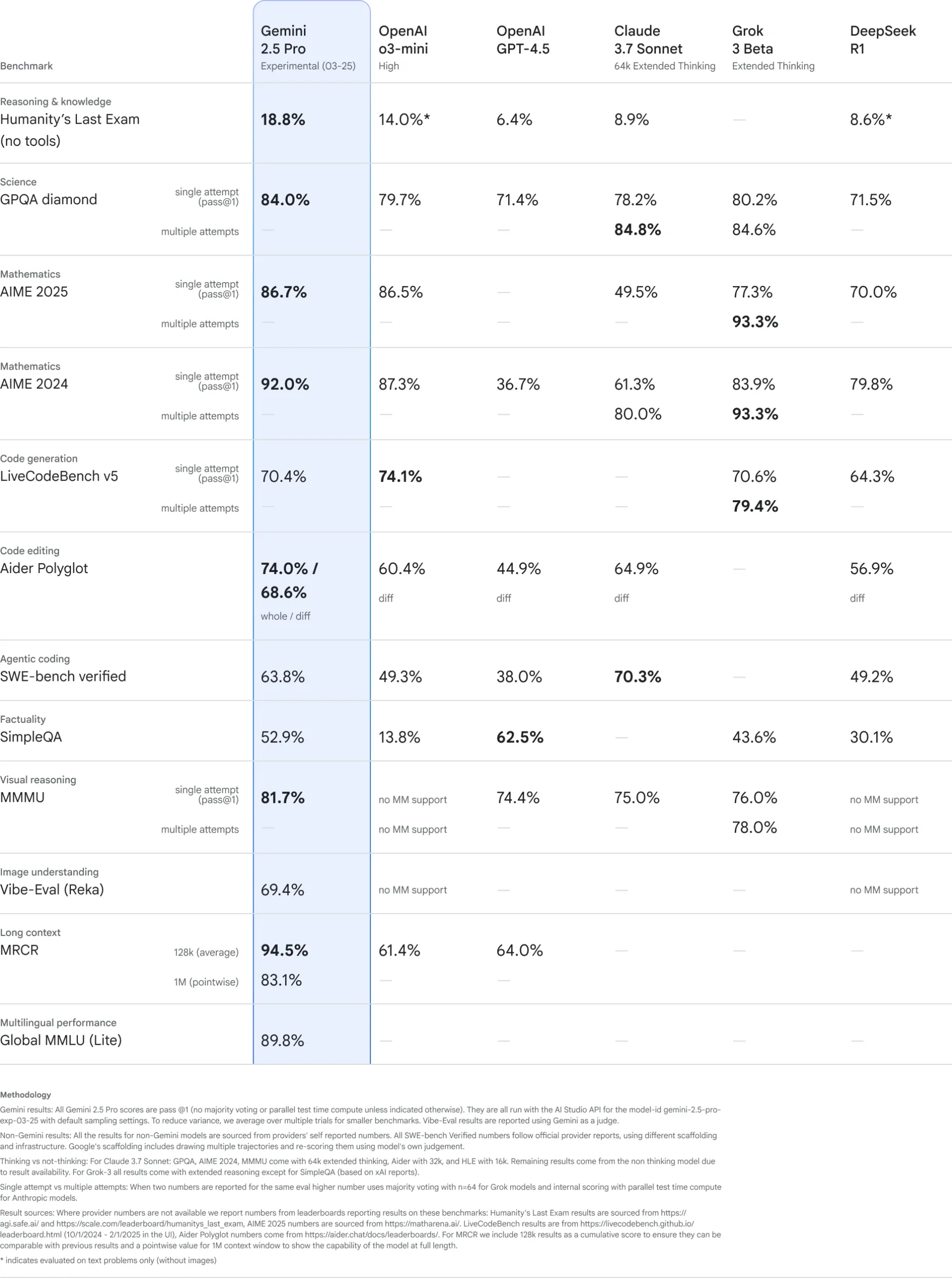
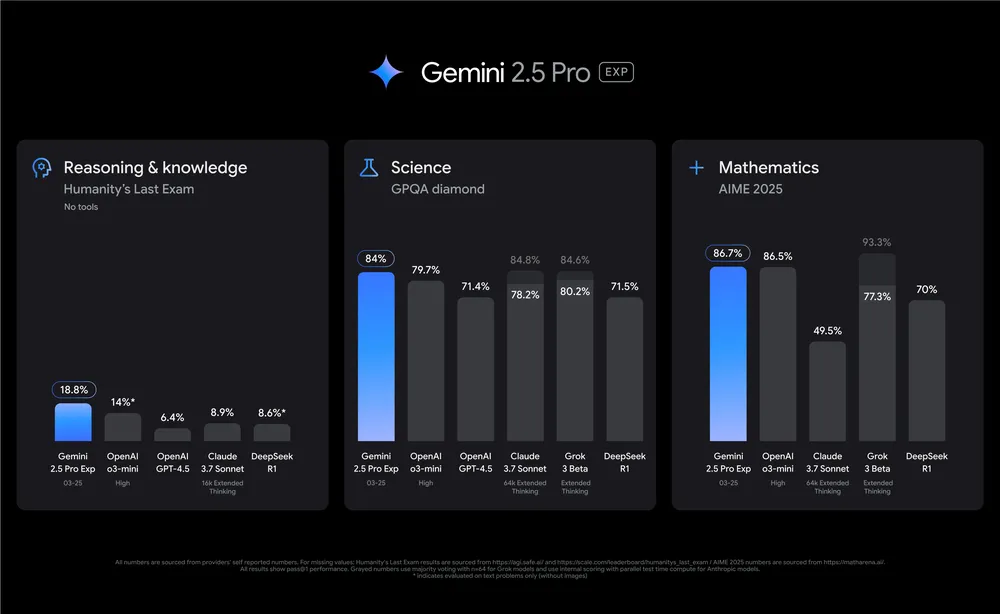
The preserved charts show Google's launch-era results. Their model versions and evaluation methods matter, including single versus multiple attempts and different agent setups. Google reported 63.8% on SWE-bench Verified with a custom agent setup; that is not a claim that the standalone model needs no tools or orchestration. A provider benchmark is also different from a measured result on your project.
Trying Useful Workflows
For document analysis, start with a manageable document and ask for an answer tied to section names or quotations. Check the cited passage in the source, especially if several documents disagree. Adding more material can help with relationships across files, but it also makes errors harder to notice. Long context does not replace a review of the original evidence.
For code assistance, provide the runtime, relevant files, error message and expected behavior. Ask for a proposed change and the assumptions behind it. Review the change, test it locally and check dependency versions rather than deploying a plausible one-shot answer. Remove credentials and unrelated private files before uploading a repository.
For video or audio, ask for timestamped observations and distinguish what is actually visible or audible from interpretation. A screen recording may show symptoms without revealing the source code that caused them. Treat a suggested CSS or JavaScript fix as a hypothesis to investigate, rather than an exact fix guaranteed by the upload.
These workflows support the original favorable view of Gemini as a capable, versatile assistant. They turn that enthusiasm into something you can assess: does it identify the right passage, preserve a requirement, explain a bug or save editing time on the material you actually use?
Access and Availability
The consumer Gemini app, Google AI Studio, the Gemini Developer API and Google Cloud deployments have different access arrangements. A consumer subscription is not automatically an API billing plan, and an API limit need not match an app's attachment limit. Check the exact product before assuming you can use the model or upload a full context window.
The Developer API lifecycle page currently says access to the 2.5 models is limited to users who actively used them previously. It lists no announced shutdown date for stable 2.5 Pro, while the old dated preview identifiers have separate shutdown entries. New users and new projects should consult Google's current model guidance rather than assuming this historical release is universally available.
The API pricing page distinguishes free and paid tiers and different costs for longer prompts. Thinking tokens are included in output pricing, and optional tools can have their own charges. Check your project's actual allowance and the current terms before uploading large datasets or sensitive information.
See the model specification, lifecycle page and API pricing for the product you intend to use.
In Conclusion:
Gemini 2.5 Pro represents a significant leap forward in the capabilities of AI. Its combination of reasoning and the ability to process substantial supplied information opens up new possibilities for how we interact with technology. From analyzing lengthy documents to creating complex content and conducting advanced research, this upgraded "brain" has the potential to make many tasks easier and more efficient. While there are other impressive AI models out there, Gemini's multimodal capabilities and available Google ecosystem integrations make it a powerful and versatile tool for the future.